
University Social Responsibility
NKUST regards university social responsibility as a core element of institutional development. In its latest medium- and long-term development plan, NKUST formally incorporated “Social Care” into its institutional characteristics and established “Sustainable Responsibility” as a core component of the five GREAT development goals. NKUST’s social impact has repeatedly been recognized by international and domestic benchmark awards, steadily transforming its USR achievements into sustainable institutional assets. In 2025, NKUST won one Silver Award and two Bronze Awards at the Asia-Pacific Sustainability Action Awards and Taiwan Sustainability Action Awards organized by TSAA. Among them, “Sustainable Upgrading of Grouper By-products” and “Sustainable Circularity through Marine Corrosion Protection” covered multiple Sustainable Development Goals. The project team of the “Good Fish Next Door Project” developed the “I-Turn Local Revitalization Credit Program” and received the Model Award in the Sustainable Courses Category at the 6th USR University Social Responsibility Awards. This demonstrates NKUST’s careful planning and support mechanisms for curriculum modularization and talent development.
I.Strategy-Driven: Strengthening the USR Support System
Faculty members are the core driving force for advancing social practice. Accordingly, NKUST has established a comprehensive support system. Through the “Regulations for Multiple Promotion Review Pathways,” USR performance is incorporated into diverse evaluation indicators covering academic achievement, technological R&D, and teaching practice. In recent years, 17 faculty members who implemented USR projects have successfully been promoted, demonstrating the close integration between USR performance and faculty career development. In addition, NKUST implements flexible salary incentives and reduced teaching-hour mechanisms to encourage faculty members to engage in social service. The University’s internal flexible salary incentives cover teaching, research, industry-academia collaboration, counseling, and service, attracting outstanding talent to remain at NKUST.
II.Practical Momentum for Project Transformation and Expansion
(I)Flagship Leadership: Ministry of Education USR Project—Taiwan Provincial Highway 17 Fishing Village Practice Project
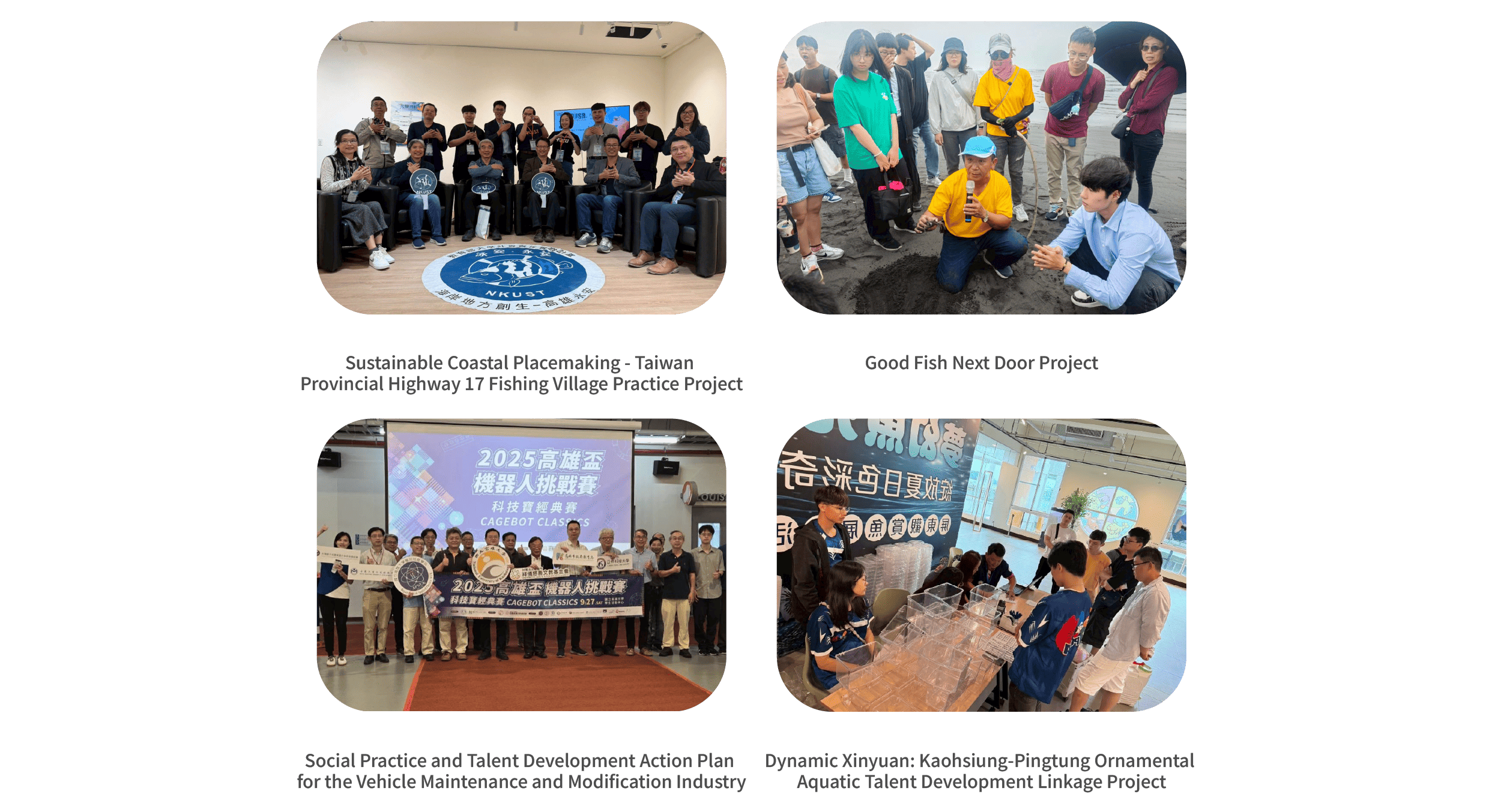
In 2025, NKUST received NT$9.5 million in approved funding from the Ministry of Education under Phase IV for the “Sustainable Coastal Placemaking - Taiwan Provincial Highway 17 Fishing Village Practice Project.” This year, the project officially introduced Social Return on Investment (SROI) analysis to use quantitative data to substantiate the project’s impact on marine ecology and community empowerment, continuing to serve as a trend navigator.
(II)Incubation of USR HUB Pilot Projects
Continuing the rolling revision of the subsidy regulations in 2024, NKUST supported a total of four USR HUB teams in 2025, with an investment of NT$2.3 million. The project scope covered industry linkage, local care, and sustainable environments. This year, a total of 26 social responsibility courses were offered, engaging 380 students deeply from within and outside NKUST in detailed practical work. These efforts embedded “talent narrative ability” and “field practice capacity” into interdisciplinary courses and precisely connected with industry demand for ESG management talent.
Representative Case Illustration
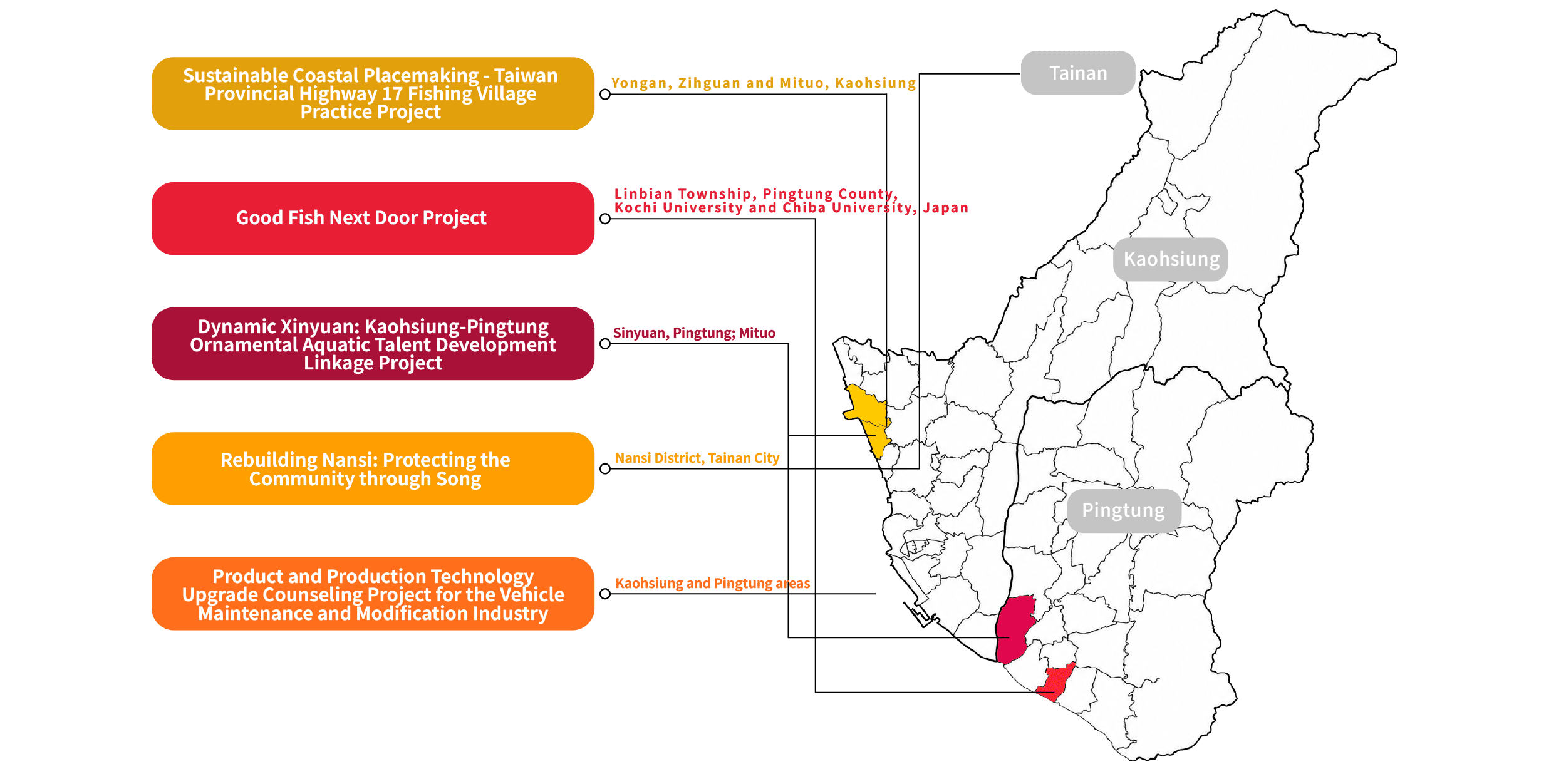
NKUST actively fulfills university social responsibility (USR) and is currently promoting five core practice projects. By leveraging interdisciplinary expertise, the University collaborates with local governments, communities, and industry to advance regional revitalization, talent cultivation, and sustainable development, transforming academic strengths into meaningful social impact.
I.“Sustainable Coastal Placemaking - Taiwan Provincial Highway 17 Fishing Village Practice Project”
(I) Local Sustainability and Ocean Protection
This year’s project uses the Taiwan Provincial Highway 17 coastal route as its axis, expanding local revitalization practice experience from deep-rooted work in Yongan to areas such as Mituo and Ziguan. In addition to continuing base renovation and environmental education, the project further invested in marine sustainability issues such as “removal of abandoned underwater nets” in 2025, protecting coastal ecosystems through concrete action.
(II) Industrial Innovation and Circular Economy
The team leveraged its R&D capacity to promote “whole-food utilization” and “value-added aquatic products,” emphasizing the spirit of circular reuse of fishery waste. The “Tiger Grouper Biscuit” (crispy fish cakes) produced by the project previously received the Superior Taste Award from Belgium’s ITQI, demonstrating NKUST’s ability to transform practical outcomes into internationally competitive products.
(III)Talent Development and Teaching Transformation
Starting in 2025, USR courses were officially refined into a University Social Responsibility Credit Program, including the “Social Responsibility Practice Micro Program” (introductory level) offered by the Center for the Liberal Arts and “Featured Course Modules” (advanced level) offered by USR teams, with the aim of cultivating sustainability talent with practical sustainability capabilities. Through PBL, design thinking teaching, and inquiry-based teaching, faculty and students are encouraged to collaborate across disciplines and transform their experience into concrete teaching practice outcomes.
Ⅱ.“Good Fish Next Door Project”
The Linbian, Jiadong, and Donggang areas of Pingtung are important aquaculture bases in Taiwan. The team focuses on issues such as the aging of fishing villages, youth outmigration, industrial transformation, cultural heritage, and fishery and food education, shaping the distinctive features of fishing villages and co-creating sustainable development. In another part of the project, under the themes of “international common good” and “transnational cooperation,” the team deepens transnational practice with Kochi University and Chiba University in Japan, as well as partner schools in Indonesia and Thailand. In 2024, the project expanded the “International Common Good - Local Care Practice Competition,” extending its impact to 20 local organizations. As a result of this long-term engagement, the project received the Model Award in the “Sustainable Courses Category” of the 2025 Global Views Monthly USR University Social Responsibility Awards, substantiating NKUST’s international mobility in the field of sustainability education.
Ⅲ.“Dynamic Xinyuan: Kaohsiung-Pingtung Ornamental Aquatic Talent Development Linkage Project”
Xinyuan Township in Pingtung is a major hub for Taiwan’s ornamental fish industry, with a strong aquaculture foundation. However, it faces challenges including young people’s reluctance to enter the industry and insufficient marketing. Through cross-university talent development and linkage with local associations, the project aims to promote fishery and food education and AI smart technologies, transform traditional aquaculture, and advance the sustainable development of fishing villages. The core of this project is to address talent gaps and technological rigidity in the industry. It offers a Smart Ornamental Fish Micro Program and promotes the introduction of AI and IoT automated control technologies to lower the threshold for young people entering the industry and increase flexibility in working hours. At the same time, it organizes guppy and clownfish breeding education and domestic and international competitions to strengthen marketing and brand power, assisting local communities in building a stable and profitable business model and enabling Taiwan’s ornamental fish technologies to shine on the international stage.
Ⅳ.“Rebuilding Nanxi: Protecting the Community through Song Project”
This project aims to integrate cultural heritage, disaster resilience, and local revitalization. Using “song” as a medium to connect collective memory and public participation, the project guides students into field practice through interdisciplinary courses; produces Hakka event songs; designs disaster prevention learning and educational activities and local tours; establishes deep connections between the University and the community; enhances local public governance capacity and cultural identity; integrates on-campus arts resources to revitalize traditional spaces; and seeks new opportunities for rural transformation through co-creation between younger and older generations. Through interdisciplinary collaboration among the Department of Cultural and Creative Industries, Department of Industrial Design, and Department of Applied Japanese, the project centers on “culture × disaster prevention × revitalization” and develops the distinctive souvenir “Nanxi Small Treasure Box.” Students participate in the full process from market assessment to packaging design and successfully assisted local associations in connecting with government local revitalization resources, concretely demonstrating the value of “universities promoting regional economic growth”.
V.“Product and Production Technology Upgrade Counseling Project for the Vehicle Maintenance and Modification Industry”
The team has long cultivated the Kaohsiung-Pingtung vehicle modification industry, dedicating efforts to upgrading the maintenance and modification industry for public welfare-oriented disaster relief vehicles and long-term care vehicles, popularizing awareness of driving safety, advocating laws and regulations for automobile modification, and promoting the social and cultural value of public welfare-oriented modified vehicles. The project shifts technical counseling toward social practice, responds to local needs through university engineering expertise, introduces public welfare application scenarios, transforms industrial culture, and strengthens social trust and sustainable industrial development. The core of the project is to use “public service needs” as the starting point for action. Through demonstration cases of public welfare-oriented modified vehicles such as disaster relief vehicles and long-term care vehicles, the project integrates engineering design, human factors perspectives, and social design, cultivating students’ technical capabilities and public communication literacy, and transforming technological R&D into social impact with public value.
Through five University Social Responsibility (USR) projects, the University addresses local needs by translating its academic strengths into practical actions for regional revitalization, promoting balanced urban–rural development and shared prosperity.
Read more: Social Responsibility Office