
About NKUST
History and Development of the University
The university was established on February 1, 2018, following the merger of National Kaohsiung Marine University, National Kaohsiung University of Applied Sciences, and National Kaohsiung First University of Science and Technology. This consolidation was a response to declining birth rates and changes in global higher education competition, aligning with government policy promoting the consolidation of higher education institutions. The school’s history dates back to the Kaohsiung branch of the Provincial Keelung Marine and Fishery Senior Vocational School, established in 1946, and has now spanned nearly 80 years. Under the guidance and leadership of successive presidents and through the concerted efforts of all faculty and students, NKUST has continued to develop steadily, integrating the strengths and resources of the three schools and gradually shaping an educational model centered on practical orientation, industry-academia linkage, and an international perspective, while advancing toward becoming a high-quality institution of higher learning characterized by both innovative momentum and social influence.
Campus Scope and Services
Located in Kaohsiung, a port city in southern Taiwan, NKUST witnessed Taiwan's industrial transformation through the merger of three schools and gradually established a diverse academic system in response to the expansion of education as well as industry demand for high-level talent. The school is centered on technical and vocational education, cultivating professional talent needed by industry, and encompasses bachelor’s, master’s, and doctoral programs as well as continuing and extension education. The campuses are distributed across key areas of Kaohsiung, including Cijin District near the port, the densely populated Sanmin District, Nanzih District in the Southern Taiwan Semiconductor Corridor (where 2 campuses are established), and the sizable university town of Yenchao District, for a total of 5 campuses, forming an institutional layout that closely links industry and urban development.
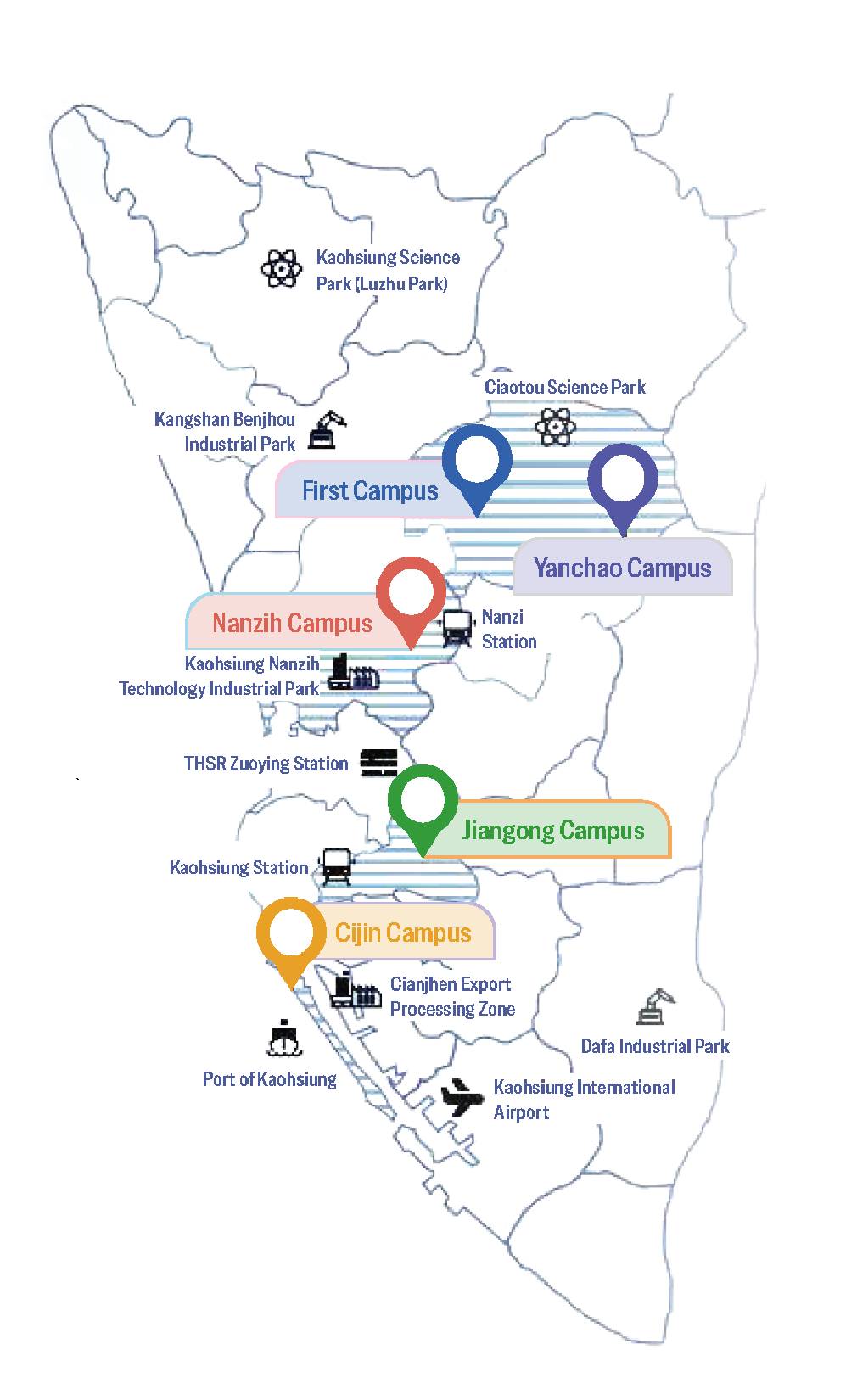
Campus Distribution Map